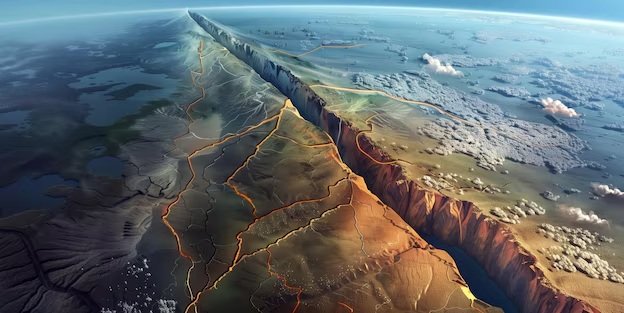
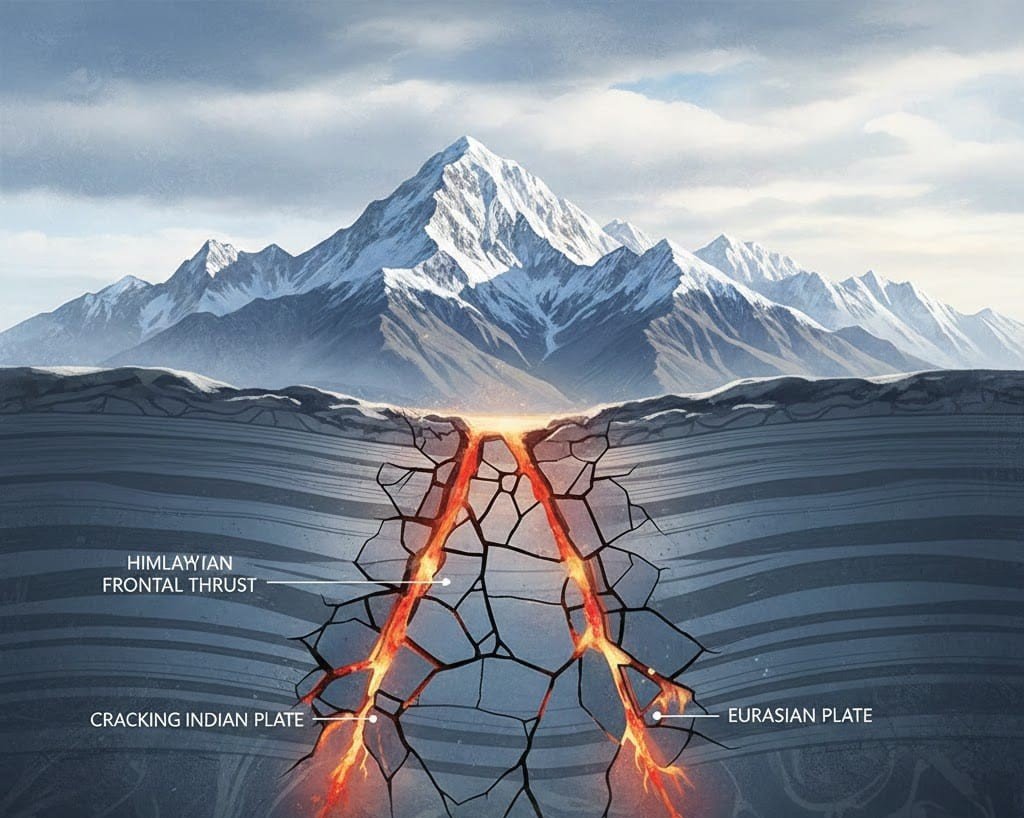
A groundbreaking geological study has revealed that the Indian tectonic plate is not moving smoothly beneath the Himalayas as once believed. Instead, it is deforming, warping, and even breaking apart deep beneath the Earth’s surface.
This discovery comes just weeks after the powerful Myanmar earthquake and offers new insight into the ongoing formation and evolution of the Himalayan mountain range.
For decades, scientists debated whether the Indian Plate was gently underplating beneath the Tibetan Plateau or subducting deeper into the Earth’s mantle. However, advanced 3D seismic imaging by an international research team now reveals a far more complex and unstable process.
The study shows a clear contrast in plate behavior on either side of the 90° East longitude. In the western Himalayan region, the Indian Plate remains largely intact, sliding beneath Tibet and extending nearly 100 kilometers beyond the Yarlung-Zangbo suture zone. This supports the traditional underplating theory.
In contrast, the eastern region presents a dramatic shift. Here, the Indian Plate is delaminating — its crust is separating from the underlying mantle. As this happens, a hot and pliable layer of the asthenosphere pushes upward between them, forming a wedge-like structure beneath the surface.
This tearing process suggests a far more violent and dynamic tectonic interaction than previously understood, reshaping scientific views on how the Himalayas continue to rise and why the region remains highly earthquake-prone.